Workplace injury coverage can be confusing if you’re an independent contractor or a business owner that uses independent contractors. In many work environments workers’ comp is mandatory, but independent contractors might not have the same choices.
One alternative which can offer some advantages for an injured contractor is known as occupational accident insurance. However, it should be noted that it is not automatically the same as workers’ compensation, and may not offer the same coverage.
What Is Occupational Accident Insurance?
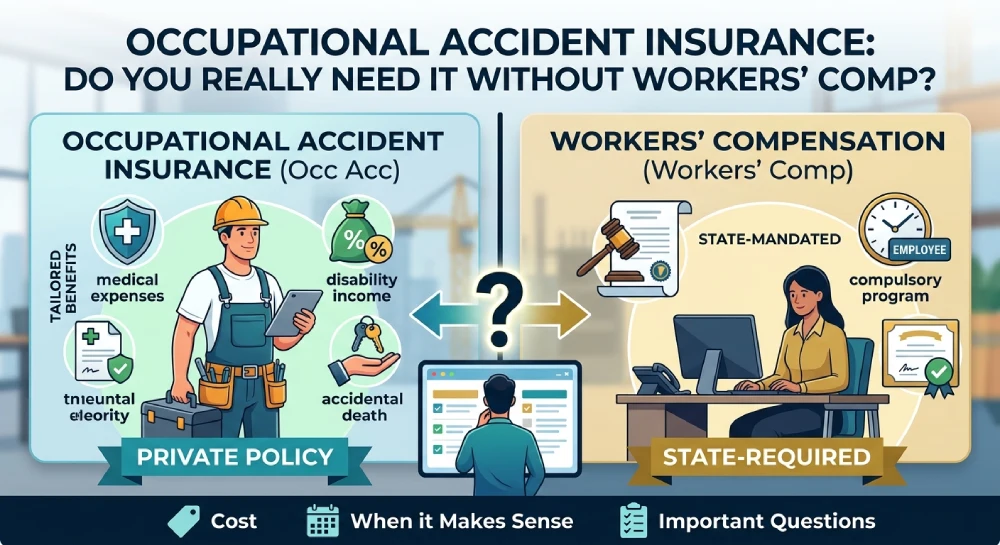
What is an occupational accident insurance? Coverage that is tailored to provide benefits for specific injuries or illnesses that may arise during the performance of a specific duty.
Occupational accident coverage, as per the policy, can assist in covering disability benefits, medical costs, accident death benefits, and any covered losses.
Specific benefits vary based on the occupational accident insurance policy and restrictions, limits, and state regulations. Contractors should check the exact details of a policy as policies vary.

Occupational Accident Insurance vs. Workers’ Compensation
One of the biggest questions is whether or not occupational accident coverage is a substitute for workers’ compensation.
Workers’ compensation is typically a compulsory program that pays benefits to workers that have been injured or have developed a health condition at work. State law and the nature of the business may dictate that they must carry it.
Occupational accident insurance is typically a private insurance policy and can be utilized by some self-employed or businesses as appropriate.
The difference is significant because workers’ compensation often provides coverage and requirements that are mandated by state law, which may not be as available or comprehensive under an occupational accident policy.
Is It Workmans Comp or Workers Comp?
People commonly search for is it workmans comp or workers comp, but the correct term is generally “workers’ compensation” or “workers’ comp.”
Workers’ compensation does not represent occupational accident insurance. The laws governing workers’ comp vary from state to state, and it’s typically linked to the employer-employee dynamic.
Occupational accident coverage is usually given for a specific contractor or enterprise circumstance and abides by the conditions of the policy.
Classification rules should be carefully reviewed should there be a question about whether someone is legally an employee or independent contractor for your business.
Occupational Accident Insurance for Independent Contractors
Occupational accident insurance for independent contractors may apply to contractors who wish to have protection from a certain kind of work accident.
Under a policy, for instance, benefits could be paid if a contractor is injured while working on the job. Some businesses might also need contractors to have specific types of insurance before they begin to work.
The key issue here is whether the policy is really necessary for the contractor as well as contractual and legal requirements.
Independent contractors should also consider other coverage which may be relevant to their business including general liability, commercial auto, professional liability or equipment coverage.
What Does an Occupational Insurance Policy Cover?
An occupational insurance policy can vary considerably from one insurer to another. Depending on the plan, benefits may include:
- Medical expense benefits
- Temporary or permanent disability benefits
- Accidental death benefits
- Certain income replacement benefits
- Coverage for specified work-related accidents
Coverage limits, deductibles, exclusions, waiting periods, and eligibility requirements can affect how much protection is actually available.
Before purchasing a policy, review what qualifies as a covered accident and which situations are excluded.
How Much Does Occupational Insurance Cost?
The factors that determine the occupational insurance cost are the type of work, the risk of the occupation, coverage limits, deductible, number of employees covered, claims history, and policy structure.
The insurance requirements vary from one contractor to another, depending on the type of work they do. A contractor doing relatively low-risk office work can have different insurance costs than one working in construction, transportation, roofing or other higher-risk occupations.
Don’t just compare the premiums, but also the benefits and exclusions. The insurance plan with a lower premium may be a less comprehensive plan, or, if it is more comprehensive, it may have lower limits.
When Might Occupational Accident Coverage Make Sense?
If an individual is an independent contractor who requires coverage for an occupational accident but is not covered by an employer’s workers’ compensation policy, a consideration might be occupational accident coverage.
This can also be applicable if a business or contract needs specific coverage for accidents.
But it shouldn’t be bought just because it costs less than workers comp. First, see if workers’ compensation is legally mandated and if the individuals doing the work are legally recognized as employees or independent contractors.

Important Questions Before Buying
Before choosing an occupational accident insurance policy, ask:
- Who is eligible for coverage?
- What injuries and illnesses are covered?
- Are benefits limited to work-related accidents?
- What medical expenses are included?
- What disability benefits are available?
- Are there exclusions or waiting periods?
- What are the policy limits?
- Does the coverage satisfy a client’s contract requirements?
- Is workers’ compensation legally required instead?
- Are additional insurance policies necessary?
Getting clear answers can help you understand whether the policy provides the protection you actually need.
Conclusion:
Occupational accident insurance is not just another type of workers’ compensation, but is important for some independent contractors and businesses.
Depending on your work situation, your state regulations, and the risks of your job, you may need the right coverage. Read the policy thoroughly and decide if extra coverage should be purchased.
If you are not sure if workers’ compensation is needed and/or if a person working for you is an independent contractor, seek guidance from an insurance professional or qualified legal professional.
Frequently Asked Questions
What is occupational accident insurance?
Medical costs or disability benefits for covered work-related accidents depend on the policy; it’s private insurance that can offer specific benefits for these situations.
Is occupational accident insurance the same as workers’ compensation?
No. Workers’ compensation is typically a state program, and occupational accident insurance is private insurance that benefits are to be determined by the policy.
Who typically uses occupational accident insurance?
It may be used by some contractors, owner-operators, and businesses working with contractors, subject to applicable laws and contracts.
Does occupational accident insurance replace workers’ compensation?
Not necessarily. It can be used as a tool with independent contractors, but it is generally unavailable to prevent a state law worker’s compensation requirement.
What does occupational accident coverage include?
Depending on the policy, it may include medical, disability, and accidental death benefits for covered work-related accidents.
Is occupational accident insurance for independent contractors?
It can be. Some independent contractors purchase this coverage to help protect themselves from certain financial losses caused by covered work-related injuries.
What affects occupational insurance cost?
Occupation, risk level, coverage limits, deductible, number of covered people, claims history, and policy benefits can all affect the premium.
Is occupational insurance required by law?
The premium can be influenced by occupation, risk level, limits of coverage, deductible, covered people, claims history and policy benefits.
What should I check in an occupational insurance policy?
This can differ from state to state and job to job. Do not assume that coverage for an occupational accident will meet a legal requirement for workers’ compensation coverage.
Should I have other business insurance too?
Possibly. Sometimes, occupational accident coverage will cover the risk of injury, but not liability, vehicles, property, equipment or professional mistakes.