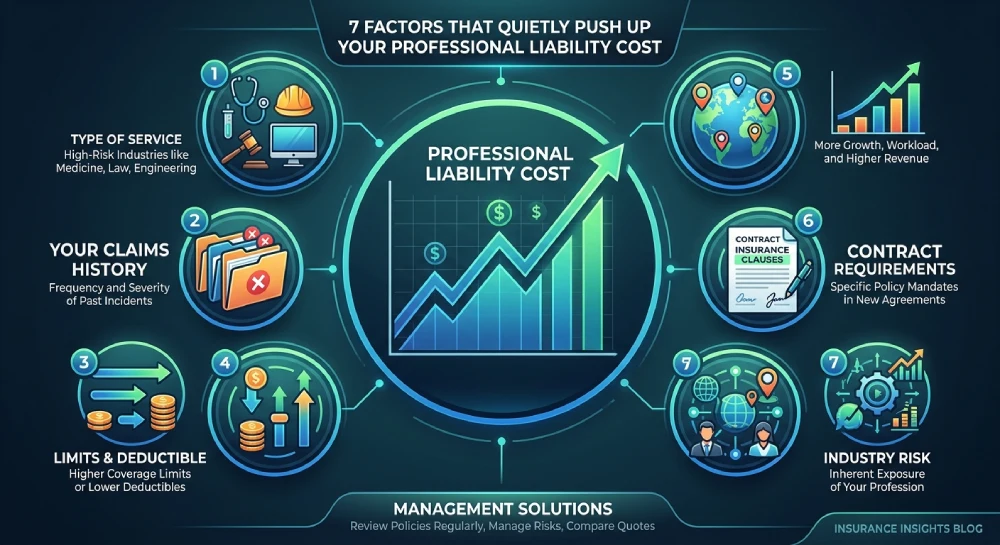
Professional liability costs may increase, even if a company does not change its operations much. Their line of work, history of claims, limits, revenue, contracts, and clients, among other factors, affect the rates: insurance companies use the data to assess the risks that a policyholder brings.
1. Your Type of Professional Service
One of the most significant factors in calculating professional liability costs is your profession. Insurers look at the sort of advice, service, or expert choice in your business. For instance, the different services of medicine, finance, engineering, law, and technical fields may have varying degrees of professional risk. This accounts for some of the differences in professional liability insurance rates that exist across industries.

2. Your Claims History
This may impact your professional liability insurance rates. Insurers might consider frequency of claims, causes of claims, and severity of claims. If a business keeps having professional negligence claims, they are likely to be seen differently than if they don’t have many such claims.
3. Your Coverage Limits and Deductible
The coverage level you opt for can directly impact the professional liability costs. A higher limit will likely offer increased protection and a higher premium. Your deductible is also a factor. A higher deductible can lower your premium, but will cost you more if you have a covered claim.
| Policy choice | Potential effect |
| Higher coverage limit | Additional coverage, possibly increased premiums |
| Lower deductible | Less out-of-pocket responsibility |
| Higher deductible | Potentially lower premium |
4. Your Business Size and Revenue
Professional liability cost may be affected by the growth of your business. The revenue, workload, number of employees, and the size of your professional operations may be taken into consideration by insurers. That’s why there is no single answer to how much professional liability insurance costs. As a business expands, it may want to adjust its policy as its service mix, revenue stream, or clientele base expands.
5. Your Location and Clients
Other cost factors include the location of your business and who you cater to. It may be necessary to take into account other legal or contractual issues if serving clients in more than one state or jurisdiction. Some clients may even need a more extensive policy or coverage amounts. Fulfilling those requirements can raise your professional liability cost.
6. Your Contract Requirements
Client contracts can incrementally raise your insurance demands without you realizing it. Certain contracts may dictate certain limits of coverage, endorsements, or other policy requirements before work is commenced. For instance, a consultant might already have insurance, but find that a new corporate agreement demands more coverage. It would be wise to check these details prior to getting into the agreement so there are no unpleasant surprises.

7. Your Industry Risk
The nature of your industry can make a big difference in professional liability costs. Various professions will have varying types of claims and financial risks. That’s why questions like the cost of medical malpractice insurance and how expensive malpractice insurance is can yield vastly different answers.
How to Manage Your Insurance Cost
While some factors are outside your control, reviewing the areas you can manage may help you keep your coverage aligned with your business.
If you’re looking to renew your policy:
- Look at the modifications to your services and earnings.
- Check your claims history.
- Verify necessary limits of coverage.
- Compare deductibles and excluded items.
- Review insurance requirements in client contracts.
Price alone should not determine which professional liability policy you choose. Two policies may cost the same, but offer different levels of coverage.
Other Liability Costs Are Different
Professional liability is used to cover claims arising from professional errors, omissions, or negligence. General liability usually covers other types of risks, such as bodily injury or property damage to others. Limited liability insurance costs and employers liability insurance costs may be associated with different types of business protection. They cannot be simply equated with professional liability rates.
Conclusion
Professional liability costs can change based on your services, claims history, business size, coverage limits, location, contracts, and industry risks. Reviewing these factors regularly can help you make sure your policy still matches your business.
When comparing policies, look beyond the premium. Consider coverage limits, exclusions, deductibles, and the protection provided so you can choose coverage that fits your business needs.
Frequently Asked Questions
What is the average cost of professional liability insurance?
No one rate is available for all businesses. The profession, claims history, revenue, geographical location, coverage levels, as well as other risk factors may affect premiums.
What affects professional liability insurance rates?
Rates may vary depending on a number of factors, such as type of professional service, prior claims, coverage limits, deductible, business size, location, and industry risk.
How much is professional liability insurance for a small business?
This is dependent on the business and risks. The quote for a medical professional, engineering type, or financial professional will be different from that for a small consulting company.
Can claims increase professional liability insurance costs?
Yes. The history of claims may be taken into account when deciding on risk in the future. All claims, of whatever type or severity, may be relevant.
Does revenue affect professional liability insurance pricing?
One of the indicators of business exposure is revenue. Your insurance quote could be impacted if there are changes in your revenue or business activity.
Why does professional liability insurance cost more for some professions?
Professions have varying risks of claims. Also, the insurance pricing for services with high-value advice, technical decisions, or financial consequences could be different.
How can I reduce my professional liability insurance cost?
Check coverage, compare quotes, keep business records up to date, select appropriate coverage amount and deductibles. Avoid compromising critical coverage in order to save money on premiums.
Is professional indemnity insurance the same as professional liability insurance?
The terms are often used for similar types of professional risk coverage. However, terminology and policy wording can vary by insurer and location, so always check the actual policy.
What is the cost of medical malpractice insurance?
Medical malpractice insurance costs vary by specialty, location, claims history, coverage requirements, and other factors. General professional liability pricing should not be treated as a medical malpractice quote.
Is professional liability insurance required for every business?
Not necessarily. Requirements can depend on the profession, location, contracts, and industry. Some clients may require coverage even when it is not legally mandatory.